
Stop guessing where to point AI.
In a value-stream assessment, our senior coaches sit down with your team and map how work gets from request to release. You leave with a shared picture of where it stalls and a clear plan for what to change first.
Our clients include









AI is writing more code than most delivery systems can absorb.
Reviews back up, and some changes skip review altogether. Where the strain shows is different in every team, so we map yours before anyone buys more tokens.
441.5%longer median time in pull request review
31%more merges with no review
Across 22,000 developers, comparing each organization’s lowest and highest periods of AI adoption. Faros AI Engineering Report 2026
Your team already knows where the work piles up.
Our coaches bring your leaders and your team together, in person or online, and draw out how the work moves day to day. The method is value-stream mapping, a lean practice with decades of use behind it.
01
Leaders map the stream
We sit down with your engineering and product leads and trace one stream of work, from the request that starts it to the release that ends it.
02
The team tests the map
Then the whole team walks a recent project through the map and tells us where it slowed down.
03
You choose what to try
Together we pick one experiment to run first and the number it should move.
Senior coaches with decades of experience run your sessions.
They ask the questions and your team does the talking. What comes out is a picture everyone in the room agrees on.
McCaul Baggett
Senior Firm Lead · Organizational Transformation
“If we speed up the wrong part of the system we get bigger queues, more rework, and a very confident dashboard. So before anybody buys anything, we find the constraint and aim there.”
McCaul has led enterprise transformation for more than fifteen years, five of them at Scrum Inc. working with Dr. Jeff Sutherland. One of those programs raised throughput 165% across a 150-team financial services organization in under a year.
Chris Sims
Managing Partner
“If we can't say whose problem we're solving and what gets better when we solve it, we aren't ready to talk about architecture, AI, agents, or tooling.”
Chris has spent more than twenty-five years building software and the systems around it. He co-founded Sigao after years of leading and coaching enterprise delivery transformations as a Scrum Inc. trainer and coach.
You leave with a clear direction and a plan you can act on.
It shows where work waits, where AI and engineering effort will create the most value, and how you will know it worked. Anything we could not measure is labelled as an estimate.
01
Where your work goes
You get every step and every loop back, the way your team described it.
02
Where it hurts
Your people say what slows them down at each step.
03
What to try first
Experiments are ranked, each with a number to move and one to protect.
04
How you will know
Records you already keep will show whether it worked.
05
Who does what next
You get the next actions, who should own each and what is still open.
Run the plan yourselves or with us.
Everything in it works without Sigao. If you want help with the first experiment, that is where AI Enablement picks up.
You see how long work sits at every step.
Your map can live on in Signal, our delivery dashboard, where every sprint adds a reading. On this screen, code review holds work for 3.3 days and has sent eight items back to coding.
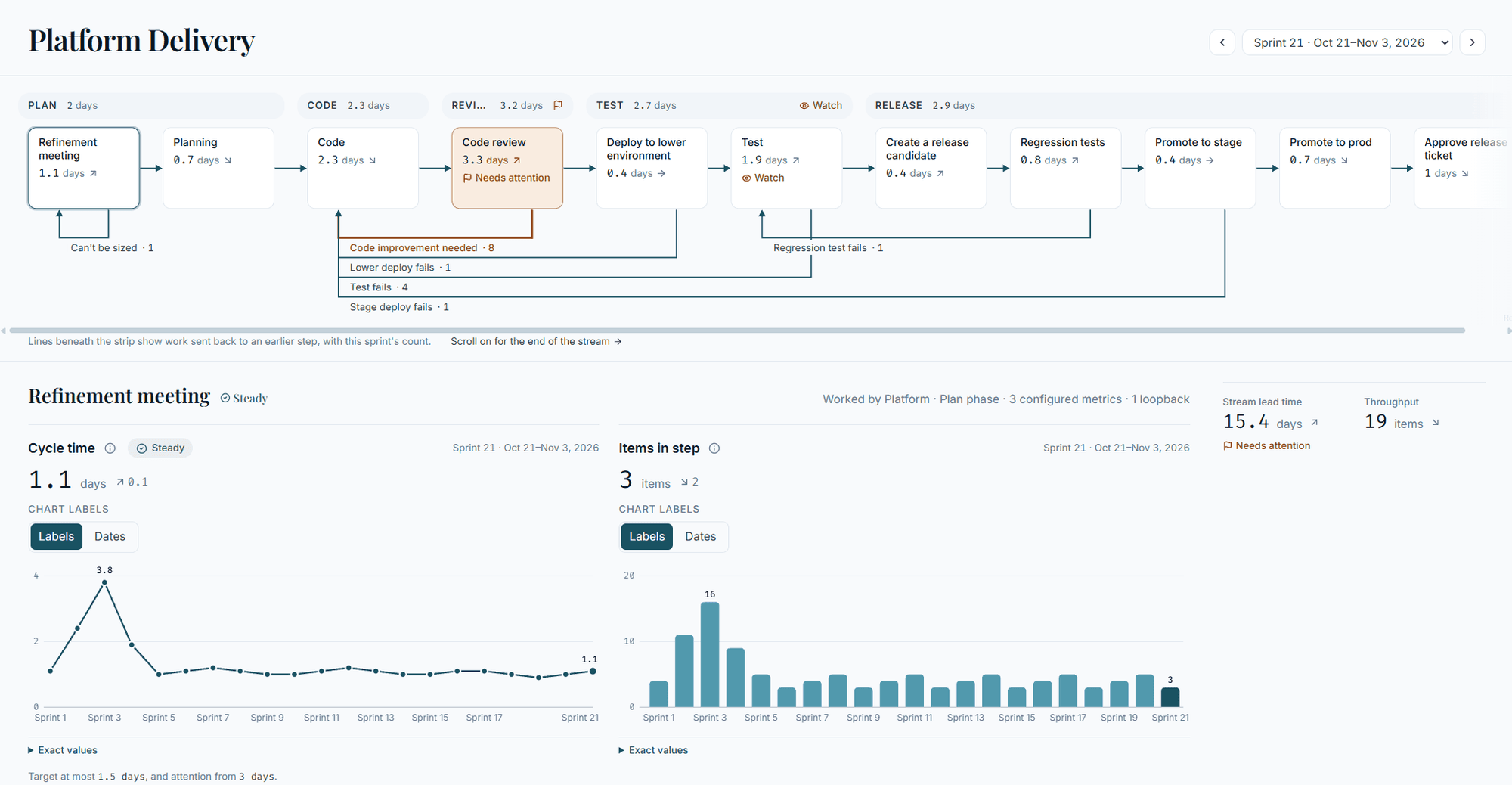
Days spent in each step
Steps that need attention
Work sent back, and why
Every measure over time
Assessments start at $5,000.
The price depends on how many teams take part and how far you want us to take it, so a smaller company pays less. We agree the scope and the fee with you before any work starts.
We run assessments in person or online.
What engineering leaders ask about the assessment.
What is a value-stream assessment?
A value-stream assessment is a facilitated workshop and a written plan that show how software moves through a team, from request to release. It uses value-stream mapping, a lean practice, to find where work waits, and it sets how improvement will be measured.
Who runs the assessment?
Senior Sigao coaches run every session with your team. McCaul Baggett leads organizational coaching and has more than fifteen years in enterprise transformation. Chris Sims, Managing Partner, has more than twenty-five years building software and the systems around it.
Can a value-stream assessment be run remotely?
Yes. Sigao runs value-stream assessment workshops in person or facilitates them online, whichever suits your team.
Who needs to take part?
Mapping needs the leaders who own the value stream, usually from engineering and product. Testing the map needs the whole team, along with people from the teams on either side of it.
How much of our team's time does an assessment take?
We agree the people, access and working sessions for your scope before we start. Our coaches run the workshop and do the analysis.
Will the assessment find our bottleneck?
It shows where your team sees friction and which experiment to run first. Confirming the bottleneck takes timing data from your own systems, and the plan says so when that data is missing.
What data do you need from us?
The workshop runs on what your people know. The baseline afterwards comes from records you already keep, such as work items, pull requests, pipeline runs and releases.
Do we need Signal to use the results?
No. The plan stands on its own. Signal is our delivery dashboard, and it can hold the same map with its readings by sprint.
Can we act on the plan without Sigao?
Yes. The plan names the measures, the owners to assign and the next steps, and your own team can carry them out. AI Enablement covers the work that can follow.
What does a value-stream assessment cost?
A value-stream assessment starts at $5,000. The price depends on how many teams take part and how far the work goes, so a smaller company pays less. We agree the scope and the fee before any work starts.
Reviewed by Chris Sims, Managing Partner. Updated November 2026.
Tell us where delivery is getting stuck.
On a first call we ask how work gets from request to release on your team, and tell you what an assessment would look at first.